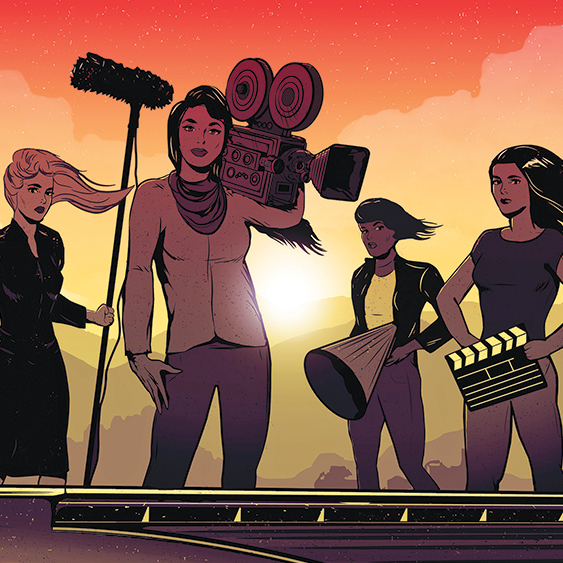
As children, we’re told we can be anything we want to be. An astronaut, or a movie star, endless realms of other possibilities. It seems that decades of systemic oppression fly out of the window any time a child tells an adult their dreams.
“There’s no such word as can’t,” they tell us.
“You can do anything you put your mind to,” they reassure you.
But it is only when we reach the age of truly wanting to achieve something, we suddenly realise that doing anything you put your mind to is a lot harder than it seems. Someone will always be standing in your way. And sooner or later you will be brought crashing down to earth with the realisation that “can’t” most definitely is a word. Leaving more and more women wondering why?
Why are we given so much hope that we can succeed, in a world where men seem so desperate for us to fail?
One place where this is abundant is the world beneath the glitz and glam of Hollywood.
The film industry.

Known for being notoriously sexist, from the stories on our screens, to behind the scenes. It doesn’t matter who you ask about equality in film, almost everyone will tell you it simply does not exist.
Put simply, the film industry is failing women, and they’re getting pretty sick of it.
More women than ever before are now working in the film industry, with numbers reaching a record high in 2019. But despite this, men still outnumber women 4 to 1 in top roles such as director or cinematographer. More and more often we are seeing a distinct lack of women making it into top categories in awards shows. Not to mention the alarmingly small number of authentic female-written stories that manage to make it to the big screen.
With 99% of women in the industry thought to have experienced sexism at some point in their career, it is clear that this is an issue that is deeply ingrained into the film industry. But with such little change being made, it is hardly surprising to hear that many have grown used to it.
In an interview with The Guardian, Lexi Alexander, director of 2015 film Suffragette told of her own experiences with sexism in the industry.
“I can list endless examples, from the driver who refused to take me because he was told to wait for the director (who was me), to the executives who insist they need a male director for a film about boxing and fighting”
Despite her skills and experience in the field, the 46 year old Academy Award nominee described how, often, she is not considered competent enough for the job of directing. The reason? Because she is a woman.
“The director is considered the general, and just like in the military, they still can’t picture anyone not born with the Y chromosome with that title.”
“I have met many people who are convinced that the number of female directors is so low because fewer women want to direct movies.”
Yet, with statistics repeatedly proving the opposite, Alexander believes one of the only ways to improve the situation would be introducing the use of quotas. Though admitting that this could tarnish a filmmaker’s reputation, she also sees no other solution.
“Let’s be honest,” she said. “nobody is going to start practising inclusion voluntarily.”

Lexi is not alone in her opinions either, it seems any number of people believe equality will never truly exist in the film industry. While of course difficult for those already working in film, this bitter pill is one even more challenging for those entering the industry to swallow.
Breaking into the industry filmmakers are, of course, well aware of the potential roadblocks they may face along the way. That much comes with the territory of an industry as competitive as this. But with a crippling gender inequality problem, women entering the industry face more than just general start up issues. Instead, they face a life of being held back at almost every opportunity – simply because of their gender. This in itself is a mountain many may not see the benefit in climbing.
Young filmmaker Chiara Fulgoni, 28, was eager to share her experiences working in film, describing herself as a huge advocate for women’s representation in the industry.
Graduating from a Masters in Cinematography in early 2019, Chiara has spent the last two years working as a crew member on a number of productions. Though considered “fairly fresh in the industry”, she has already taken on various roles on sets, from Camera Assistant to Gaffer and Spark. Perhaps due to how long she has worked in the industry, or maybe just pure luck, Chiara has found herself working with a lot of women throughout her career so far.
“I always work as part of a team and I’ve been pretty lucky with gender diversity up to now. I think women in the industry just tend to gravitate towards each other.”
Interestingly, Chiara noted that despite the diversity she has been lucky enough to experience, it is not without its catches.
“The sets where I’ve encountered a lot of women have always been very small, no budget productions. I know that the bigger the production, the less you see women in crew member roles.”
Not only are women seen less on larger productions, but many including Chiara claim to notice a significant difference in their self confidence based on the gender inclusivity they experience on a job.
“I once worked on a production which made it the goal to have only women on set, with the exception of the male actors needed for the story. With the storyline being based around sexual consent, the writer and producer felt it was important to her to have women creating the story,” says Chiara.
“Working on this set felt so comfortable to me. I was working in a role that many consider a “male role”, but because of the understanding and camaraderie of an all women set, nobody questioned my knowledge. I didn’t feel at all anxious, which I often find I do on more male-dominated sets.”
Her experience, which is likely one of many similar, represents a worrying precedent that has been set within this industry. One that almost automatically sets to seal a woman’s fate the second she begins her career.

To many, it seems that men appear to be given better opportunities, and more of them, despite possessing the same skills as their female counterparts. From the offset, it is as if they are set up to succeed, while women are left picking up the pieces of their own setbacks.
“It’s very much an industry run on connections and often the men who are given these opportunities will link up and recommend each other for jobs. It feels like a club that women aren’t welcome in.” Chiara says.
“As a cinematographer, the defeminisation of my job really frustrates me. I understand that it is down to the fact that the film industry started off with absolutely no women, but it’s 2020. Change might be happening slowly but it’s just not quick enough.”
And it is true, despite evident changes in the film industry since its beginning, not nearly enough progress has been made where gender equality is concerned. Awards shows continue to be dominated by men. Stories are still being told with male audiences in mind. And women have to fight tooth and nail to get their foot in a door that men waltz through with ease.

Last year, the Hollywood Foreign Press Association came under fire for a huge lack of gender diversity at the Golden Globe awards, after presenting a number of categories with not a single female nominated. Though 2019 saw a record-breaking number of films directed or co-directed by women, they were still omitted in favour of their male counterparts.
Even with a plethora of talented women staring the HFPA, and the rest of the industry blankly in the face, the 2020 awards season only managed to prove one thing. That while on the surface the industry continues to present victories in terms of gender equality, one only has to look deeper to see that these “victories” are more an anomaly than a genuine reflection of progression. And that until regular, visible progress is made in this industry, the promise that we can do anything we put our minds to is nothing but a pipe dream.
Chloe Rose
Leave a Reply